

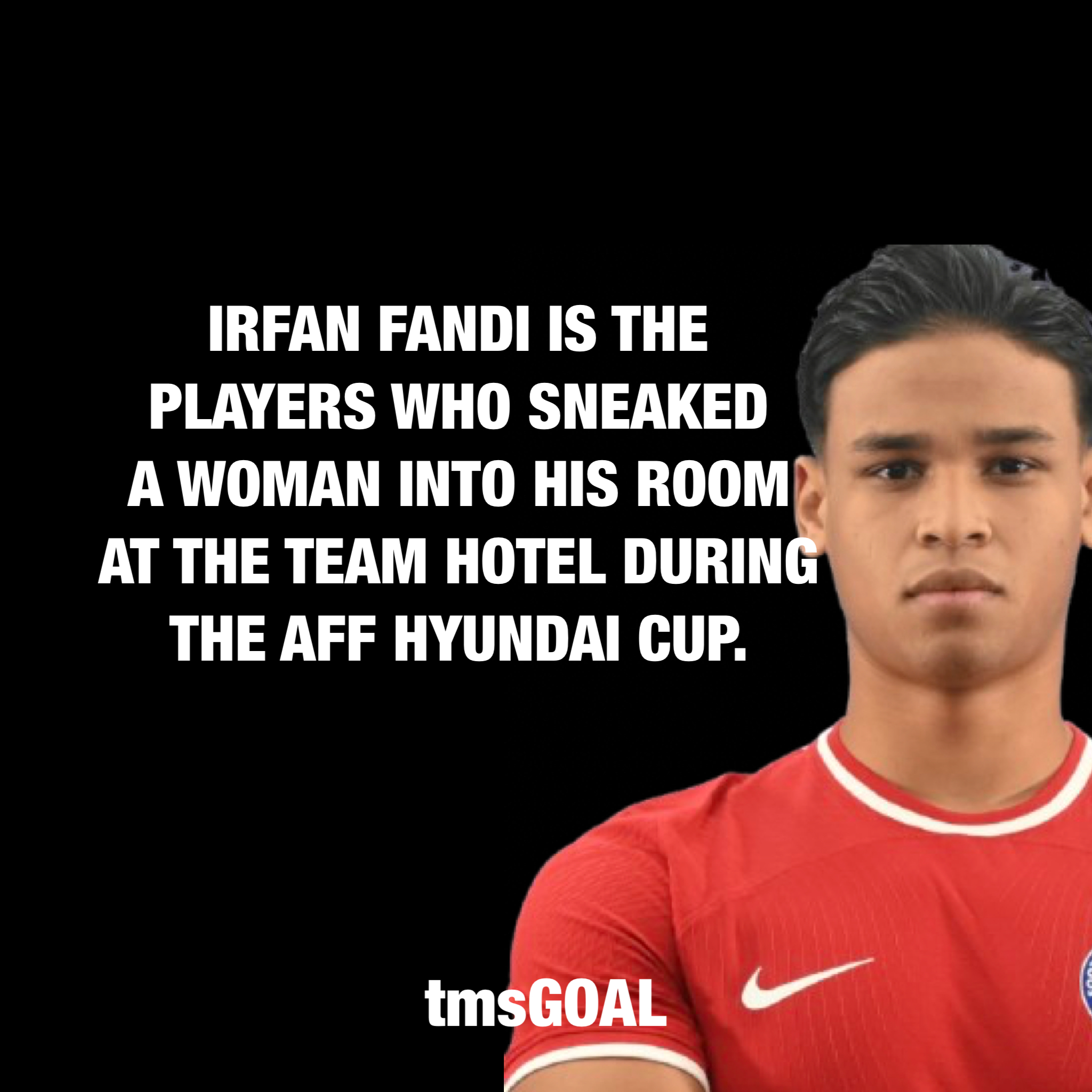
Irfan Fandi is the Singapore national footballer who sneaked a woman into his room at the team hotel during the ASEAN Football Federation Hyundai Cup in August.
TRIGGER WARNING. DETAILS ARE GRAPHIC.
TMSGOAL has decided to make this information public for various reasons, which we will address.
These are details about the incident which we have ascertained and verified, and which we are very clear took place.
The incident happened on the night after the Lions lost to Thailand at the Jalan Besar Stadium in the first-leg semi-final.
That very night, between 3am to 4am, Irfan Fandi woke up his room-mate – Harhys Stewart – and asked him to head over to continue sleeping in the team medical room.
Stewart has played the full 90 minutes in the clash against Thailand and the team was also due to travel to Bangkok for the return leg just hours later.
The medical room is adjacent to the team physiotherapist’s room.
Irfan woke Harhys up and told him to sleep in the medical room, so he could have his groin itch fulfilled by sneaking in the woman into his room. It is not known who the woman was but that is immaterial.
What is bothersome about this entire incident is when the issue was discovered, and when it was reported, and the security risks the FAS does not seem to recognise.
The critical questions:
When was this incident discovered?
When was it reported upwards?
Did the team physiotherapist report to the head of national teams or the team manager when she discovered that Stewart was sleeping in the medical room instead of his own room?
Was her delay in reporting upwards caused by a personal conflict of interest?
More worryingly, where was the security on the floors where the Lions were housed?
How could a stranger walk into the team premises during a major tournament?
Has the FAS not understood the importance of risk assessment and analysis, and mitigation?
Has it not read up what transpired at the 1972 Munich Olympics and also learnt how national teams manage team security at major competitions like the World Cup?
Also, why did the FAS not make this incident public and also share what actions were taken against Irfan Fandi, and how it will tighten up processes within the team management?
Why is it the FAS (albeit previous management teams) can vilify national players like Shakir Hamzah and Ahmad Latiff Khamaruddin but then be silent about what the son of Fandi Ahmad has done?
Is that the reason why the FAS chose not to call a Media Day before the team left for the FIFA ASEAN Cup? To prevent any uncomfortable questions about this entire incident?
What kind of message does this serve? That you have little or zero accountability?
So many questions but the leadership has not said a single thing at all, thus far. Why? Hoping it will all go away? Or that no one was going to start talking about it? Does FAS not realise the existence of CCTVs on all hotel floors or the power of word of mouth marketing?
Let’s be clear.
The Lions are headed to the Asian Cup. They qualified on merit for the first time in Singapore’s football history.
Our footballers have stepped up and have lifted their standards. They have brought hope to a tiny football-loving nation.
It’s time for the management to lift its standards too.
This is not a kampong affair any longer.
As for Irfan Fandi, you owe the public and the Singapore football fans an apology. It’s time to grow up and take responsibility for your actions. Don’t think that the surname will protect you in any way.
Our intent is clear. It is not to destroy one player.
It is to protect the team, for the greater good. Because that’s what team-mates do. Look out for each other.
Good team-mates do not wake each other up in the middle of a much needed rest after a battle royale in the middle of war, just so you can stick your banana into somewhere warm and moist.
But the FAS is not devoid of blame. Irfan Fandi failed because the systems in place allowed him to trip over himself. And that is on the FAS management team.
Let this incident be yet another leaning lesson for the FAS, and another case study for other organisations.